Tavarus Hester
The Short and Tragic Life of Robert PeaceTavarus Hester enters the story as the prized swimming recruit of St. Benedict’s freshman class and becomes one of the four friends who form the daily emotional center of Rob Peace’s life. His trajectory moves from parental loss, reckless indifference, and a 0.7 freshman-year GPA toward disciplined study and the first faint image of college. Through him, the book shows both the power of friendship as social support and the fragility of upward mobility when a young person must build a future while carrying grief and anger.
Identity and Background
Tavarus is short, scrawny, and an experienced natural swimmer. He grew up in East Orange with a single parent after his mother repeatedly disappeared for periods of six months or a year and finally left for good when he was twelve. His father raised him and his older brother, serving simultaneously as parent and best friend, until he died suddenly of cancer during Tavarus’s eighth-grade year. The illness began as a persistent stomachache; three months after seeking medical attention, his father was buried.
Tavarus had entered St. Benedict’s with significant financial aid, the last positive development before his father’s death. Afterward, he lived with his aunt and grandmother, supported by Social Security checks. The loss left him in a state of deliberate emotional refusal: he cared about drinking, smoking, and swimming, and appeared to care about little else. His anger therefore parallels Rob’s, although the sources differ. Both boys carry a sense that the world has failed them, but Tavarus’s immediate wound is the disappearance and death of the people who had been responsible for him.
Friendship with Rob Peace
Tavarus was assigned to Rob’s color group during Summer Phase, the intensive St. Benedict’s introduction in which 140 fourteen-year-old boys arrived from forty towns and sixty middle schools. The school demanded trust, unity, and the making of men, but Tavarus recognized in Rob an anger running alongside his own. When football was taken away from Rob, Tavarus urged him to swim, describing the water as a place where complicated life could be reduced to oxygen, buoyancy, and propulsion.
Rob listened. Swimming that winter and water polo the following fall brought him into the circle that included Tavarus, Drew Jemison, Julius “Flowy” Starkes, and Curtis Gamble. The team’s unusual identity mattered: it was composed of minority students and was assumed to be perhaps the only all-minority water polo team in the country. Tavarus’s invitation therefore did more than redirect Rob’s athletic life. It gave him access to a brotherhood whose members carried different versions of abandonment, poverty, violence, and family instability.
The friendship was reciprocal, but not symmetrical. Tavarus supplied the invitation into the water; Rob supplied structure. When freshman grades were posted, Rob’s 4.0 stood near the top of the list while Tavarus’s 0.7 appeared at the opposite end. Rob knew that Tavarus was struggling emotionally, yet he did not force a confession or expose him. Instead, he organized a weekly study group after swim practice, accepting that helping his friends would slow his own academic progress.
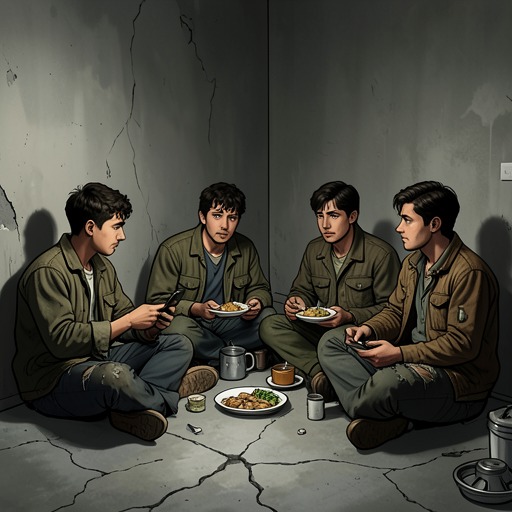
The study group found its physical home in the basement of 34 Smith Street, Curtis Gamble’s house. Curtis’s mother fed the boys after practice, while the cramped basement, refrigerator stocked with soda, and piles of books became a clubhouse and refuge. Rob taught Tavarus and the others what they needed for classes, including subjects he was not taking himself. Curtis’s father repeatedly spoke of college as though it were guaranteed for all of them, and for Tavarus that ordinary assumption represented a kinder future he had never believed he was entitled to imagine.
The Maine Retreat and Academic Reorientation
Tavarus’s most visible turning point came through a retreat at the Maine estate of Charles Cawley, St. Benedict’s largest benefactor. Cawley opened the property each summer to twelve students from different academic levels and troubled circumstances. Tavarus was chosen among the academically weakest students, and the experience placed him inside a world of catered lobster dinners, private bedrooms, bathrooms, maids, fishing trips, and lectures from financial executives.
The contrast did not immediately make him grateful or cautious. During the retreat, he started a fistfight after another student commented on his shoes. Ordered to call home and explain himself, he called Rob instead. Rob responded in the stern, patient register of the father Tavarus had lost, challenging the logic of starting a fight while being served steak and lobster and living in luxury. He told Tavarus to stop letting foolish provocations control him and to think about the larger picture.
The rebuke mattered because it translated privilege into responsibility rather than fantasy. After returning from Maine, Tavarus enrolled in additional summer tutoring and allowed Rob to coach him in the practical mechanics of studying: taking useful notes, identifying the central material in each subject, and refusing to become lost in details. His 0.7 GPA remained a deep hole, and the narrative does not present academic recovery as easy or complete. What changed first was his capacity to picture a different life.
Tavarus began imagining himself on a distant college campus, walking across grassy quads with an armful of books. At first the image was grainy. It sharpened as he watched Rob work. Rob’s intelligence was not effortless talent but sustained labor: in his small second-floor room on Chapman Street, shelves were packed with composition books whose pages were filled, front and back, with single-spaced notes. Tavarus came to understand that achievement was made through dogged reading and meticulous preparation. Rob’s example converted college from an abstraction into a method, and then into a possibility.
Group Life and Shared Refuge
The water polo team extended the boys’ friendship beyond the school day. Because only three New Jersey squads, including St. Benedict’s, played the sport, the team traveled frequently to tournaments in Pennsylvania, Connecticut, and Massachusetts. The players crowded seven or eight to a room in inexpensive Motel 6 or Super 8 accommodations, creating a mobile version of the same compressed intimacy they found in Curtis’s basement.
Tavarus participated in the teasing and rough humor that held the group together. On one early sophomore-year trip, when a teammate distributed a six-pack of Bacardi Breezers, Rob refused one and mocked the young men sitting on cheap hotel mattresses with pink drinks. Tavarus answered by joking that Rob was so hard he should bring the party supplies next time. The exchange shows Tavarus not simply as a troubled student receiving help, but as an active friend capable of puncturing Rob’s posturing and preserving the group’s humor.
The basement at 34 Smith Street remained the deeper center of their lives. There, the boys were warm, fed, and protected from the conflicts surrounding their homes and neighborhoods. Their histories were not initially discussed directly; they talked about music, food, parties, practice, teachers, and coaches. Yet their unspoken circumstances joined them. Tavarus’s fatherlessness and bereavement, Flowy’s exposure to lethal violence, Rob’s imprisoned father, and the other boys’ family histories formed an unseen foundation beneath their ordinary conversations. For Tavarus especially, Curtis’s household offered an image of family continuity: Curtis’s mother fed him, and Curtis’s father’s presence made a stable adulthood seem imaginable.
Narrative Role and Significance
Tavarus functions as both companion and counterpoint to Rob. He is talented but academically adrift, angry but not yet organized around a clear objective, and hardened by loss while still capable of responding to care. Rob’s intervention demonstrates the educational ideal embodied by St. Benedict’s: achievement is not merely individual brilliance but a network of discipline, mentorship, food, shelter, friendship, and expectation.
At the same time, Tavarus’s story complicates any simple account of merit. He receives access to an elite school and a transformative retreat, yet those opportunities arrive after his father’s death and alongside a GPA that reflects emotional devastation rather than lack of ability. The college image he develops is therefore not a triumphant certainty but a fragile construction, assembled from Rob’s notebooks, Curtis’s father’s repeated assumptions, and the temporary experience of a wealthy estate.
Tavarus also helps define Rob’s character. Rob can be uncompromising, prideful, and dangerously reactive, but with Tavarus he becomes a tutor, organizer, critic, and surrogate source of paternal guidance. The relationship reveals Rob’s capacity to convert his own discipline into collective care. It also foreshadows the book’s larger tension: education can open a path beyond Newark’s violence and deprivation, but the path depends on relationships and resources that remain precarious. Tavarus’s awakening to study is one of the story’s clearest instances of possibility taking shape—not as an escape from grief, but as a way of learning to carry it toward a future.